Published Oct 23, 2026Updated Oct 23, 2026
Gundri 01|Size Guide
A practical guide to choosing the right Gundri size, from portable seat cushions to larger floor mats, with notes on combinations, materials, and everyday use.
Gundri is available in two seat-cushion sizes, 35 × 35 cm and 45 × 45 cm, as well as M and L floor mats.
From small mats that are easy to carry to larger floor coverings that can be used by several people, each size can be chosen according to where it will be used, how many people will use it, and whether portability is important.
The main difference between 35 cm and 45 cm is portability versus seating room.
The difference between M and L is compactness versus floor area.
Use this guide as a reference when choosing a size.
_
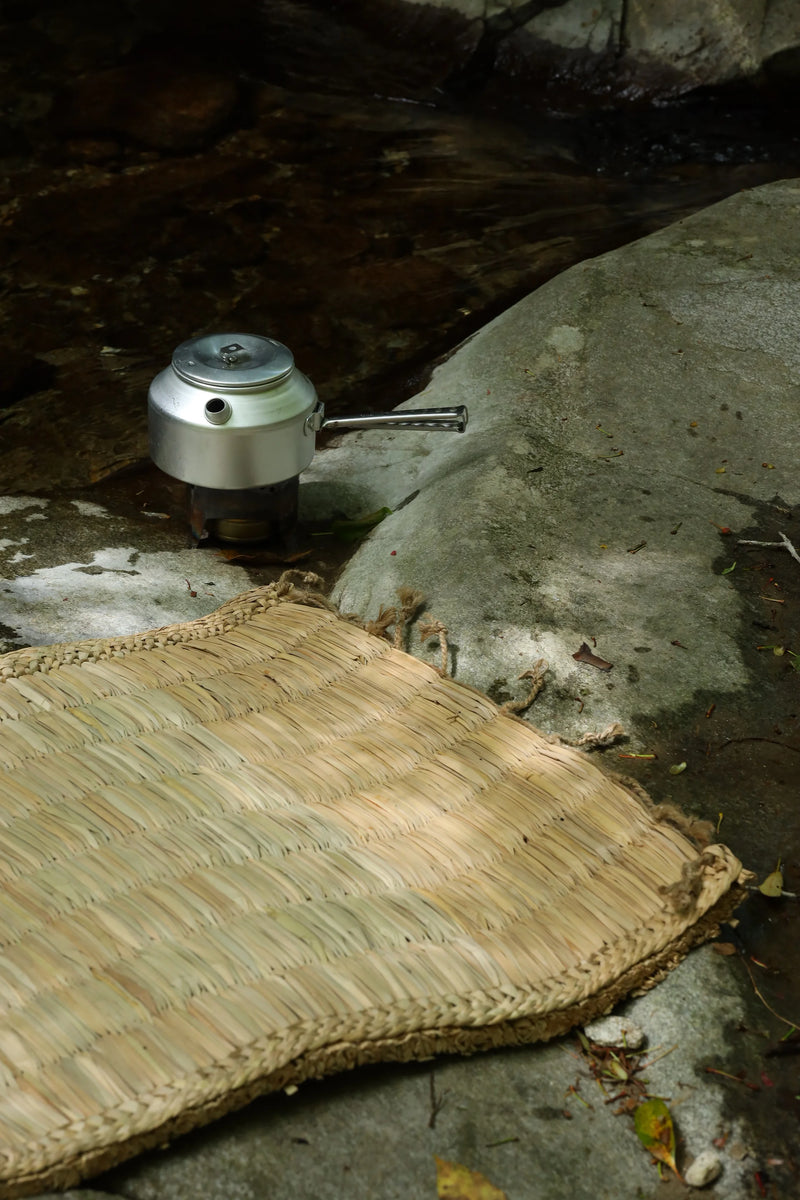
Many of the photographs in this article show Gundri being used outdoors.
Gundri can be used outside, but it is not made specifically or exclusively for outdoor use. After use, allow it to dry thoroughly so that no moisture or soil remains, and wipe it lightly when needed before storing.
35 × 35 cm
The smallest and easiest size to carry. It can be used as a seat cushion or small floor mat, and when rolled it fits into an eco-bag or similar bag.
Use it to sit on, support your back, or place beneath belongings. Its compact size also makes it easy to handle on walks and while spending time outdoors.
35 × 35 cm|approx. 100 g


45 × 45 cm
One size larger than 35 cm, with more room around the seated body. It accommodates the body more easily when sitting cross-legged and works well as a cushion for floor seating or outdoor use.
With moderate thickness and flexibility, it can also be rolled and used as a simple pillow.
45 × 45 cm|approx. 300 g


35 cm and 45 cm

35 × 35 cm
For those who prioritize lightness and portability.
45 × 45 cm
For those who want more room around the seated body.
Choose 35 cm when portability is the priority, and 45 cm when you want more space for floor seating.
M|53 × 210 cm
An elongated size well suited as a floor mat for one person. At approximately 53 cm wide, it provides enough space to lie down or sit with the legs extended while still fitting neatly indoors.
One end can be rolled into a simple pillow. When not in use, the entire mat can be rolled and stored upright.
Its narrow width also makes it useful as a base for displaying small objects, and multiple mats can be connected lengthwise.
M|approx. W53 × L210 cm|approx. 2 kg


L|90 × 210 cm
The largest size, wide enough to turn over comfortably while lying down. It can be used spaciously by one person or as a mat for several people to sit on.
Approximately 90 cm wide, it suits living rooms and bedrooms where a larger floor area can be used. It also provides enough room to place a round table or fixture around 60–70 cm in diameter with space around it.
One end can be rolled into a simple pillow. When not in use, the entire mat can be rolled and stored upright.
L|approx. W90 × L210 cm|approx. 3 kg


M and L
M|53 × 210 cm
For a floor mat for one person and when you want to keep the space visually compact.
L|90 × 210 cm
For spacious individual use or for several people.
Choose M when you want to limit the width of the mat. Choose L when you want enough room to turn over while lying down or plan to use it with several people.
Combining 35 cm and 45 cm
The 35 cm and 45 cm sizes can be used individually or combined to expand their uses.
For example, place 45 cm beneath the body and 35 cm behind the back to support each area separately. Reversing their positions can also provide more room around the shoulders when lying down.
They can be separated for belongings, used one per person, or rearranged according to the place and how you spend the day.
35 cm × 2
A combination that prioritizes lightness and portability.
35 cm + 45 cm
A flexible combination for sitting, lying down, or placing belongings.
45 cm × 2
A more spacious combination for relaxed use.


Combining M and L
Both M and L are approximately 210 cm long, so different sizes can be aligned and combined.
Placed side by side, M + L creates a width of approximately 143 cm. The floor area can be adjusted according to the number of people and the amount of space required.
They can also be connected lengthwise. Two M mats create a total length of approximately 420 cm. Any excess can be rolled, allowing the length to be adjusted to the space.
In addition to floor use at home, Gundri is also used as a base for fixtures and displays in exhibitions and shops.

A Material That Conforms to the Ground
Gundri is made from Pater, a water grass that grows wild in southern Nepal. Pater has flexible, sponge-like fibers with moderate thickness and resilience.
Rather than creating a uniformly flat surface, the material gradually conforms to the contours of rocks and the ground, supporting the body while softening hardness and cold.
This ability to adapt to different terrain—rocky ground, riverbanks, grass, or earth—is one of Gundri’s characteristics.
※ After use outdoors or in a humid environment, allow the mat to dry thoroughly and wipe it when necessary. Proper drying and care help prevent fiber deterioration and insect damage.


Front and Back
Gundri is made with the side showing the mesh pattern along the edge as the front.
Both sides can be used, but the front feels softer against the skin and the weave appears more even. As a general rule, use the side with the mesh pattern facing up.


Size Comparison
| Size | Main uses | A guide to choosing |
|---|---|---|
| 35 × 35 cm | Carrying / Individual seating / Placing belongings | Lightness and portability |
| 45 × 45 cm | Floor seating / Cross-legged sitting / Simple pillow | More seating room |
| M|53 × 210 cm | Floor mat for one / Narrow spaces / Display fixture | Space efficiency |
| L|90 × 210 cm | Spacious individual use / Multiple people | Width, room to turn over, multiple-person use |
35 cm / 45 cm
Choose 35 cm for portability, and 45 cm for more seating room.
M / L
Choose M to keep the space compact, and L for greater width or use by several people.

Because each Gundri is handwoven from natural materials, there are individual differences in color, thickness, fiber fineness, dimensions, and shape. Fine fibers may also shed with use.
Some pieces have a bluish cast immediately after finishing, but with drying, use, and age they gradually shift toward beige, while the volume of the fibers settles over time.